
Artificial Intelligence has evolved from being a futuristic concept to an everyday business necessity. Among its many advancements, Generative AI is transforming how B2B marketers create content, engage prospects, personalize campaigns, and drive measurable business outcomes.
Unlike traditional automation, Generative AI doesn’t just execute repetitive tasks—it creates. From writing compelling emails to generating campaign ideas and analyzing customer data, it enables marketing teams to work faster while maintaining quality and consistency.
As competition intensifies and buyers expect personalized experiences across every touchpoint, B2B organizations that embrace Generative AI are gaining a significant competitive advantage.
What is Generative AI?
Generative AI refers to artificial intelligence models that can create original content based on user prompts or existing data. These models generate text, images, presentations, code, videos, and even strategic recommendations.
For B2B marketers, this means spending less time on repetitive content creation and more time on strategic planning, customer engagement, and revenue growth.
Why Generative AI Matters in B2B Marketing
B2B buying journeys are longer and involve multiple decision-makers. Marketers must consistently deliver valuable, relevant content at every stage of the buyer’s journey.
Generative AI helps by:
- Accelerating content production
- Improving campaign personalization
- Supporting account-based marketing (ABM)
- Enhancing lead nurturing
- Reducing operational costs
- Enabling data-driven decision-making
Let’s explore the most impactful use cases.
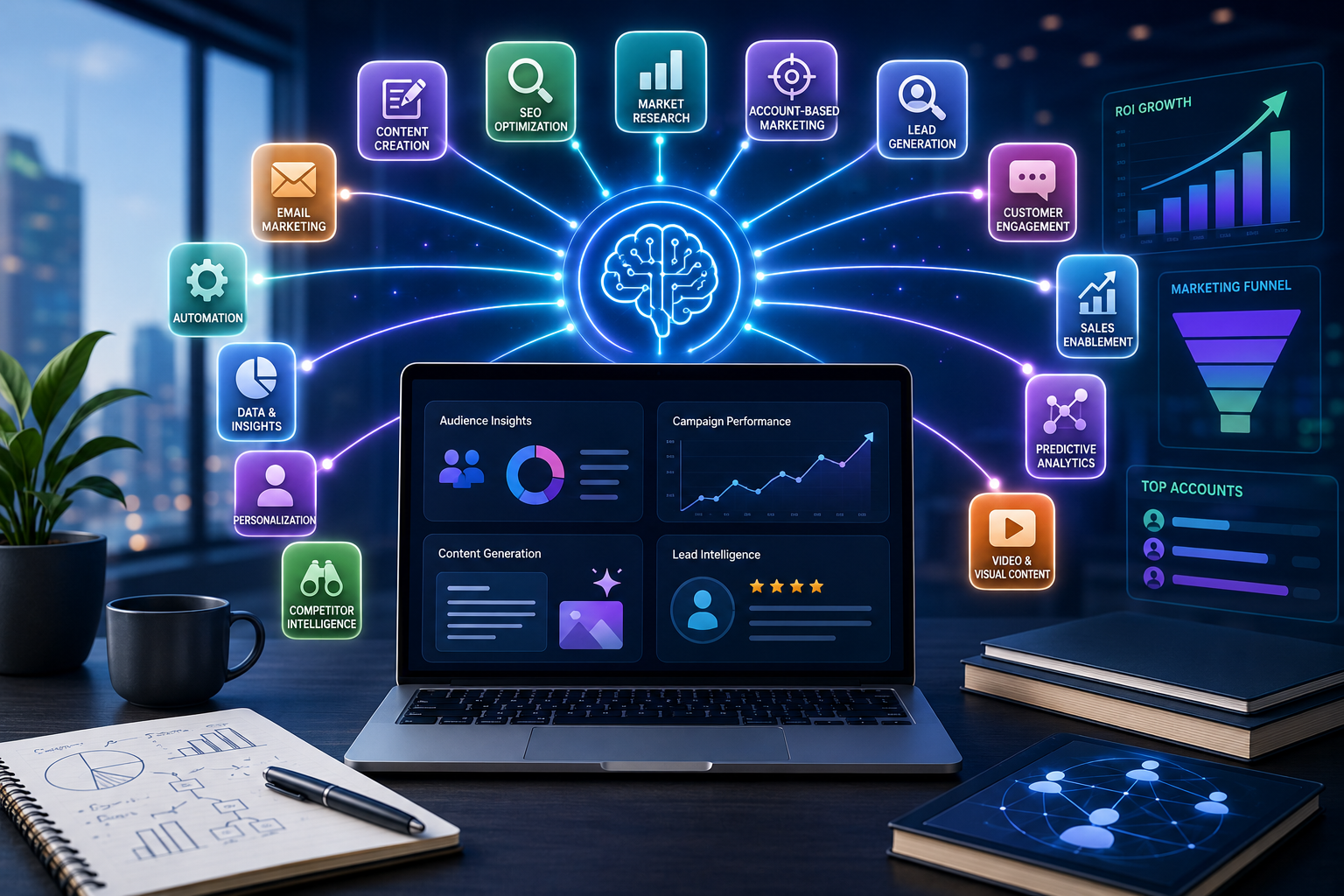
1. Content Creation at Scale
Creating blogs, whitepapers, landing pages, newsletters, product descriptions, and social media content requires significant time and resources.
Generative AI can assist marketers by:
- Drafting blog posts
- Creating website copy
- Writing email campaigns
- Generating social media posts
- Producing case study outlines
- Repurposing existing content into multiple formats
Instead of starting with a blank page, marketing teams begin with AI-generated drafts that editors can refine, significantly reducing production time.
2. Personalized Email Marketing
Personalization is no longer optional.
Generative AI can create tailored emails based on:
- Industry
- Company size
- Job title
- Previous interactions
- Purchase history
- Buyer stage
Instead of sending one generic email to thousands of prospects, marketers can generate hundreds of highly personalized variations that improve open rates and conversions.
3. Smarter Lead Nurturing
Not every lead is ready to buy immediately.
Generative AI helps build customized nurturing sequences by generating relevant educational content, follow-up emails, webinar invitations, and product recommendations based on each lead’s behavior.
This creates a more engaging buyer journey while reducing manual effort.
4. Social Media Content Generation
Maintaining an active social media presence can be challenging for lean marketing teams.
Generative AI helps generate:
- LinkedIn posts
- X (formerly Twitter) updates
- Facebook posts
- Campaign captions
- Poll ideas
- Industry insights
- Content calendars
It also helps repurpose long-form content into bite-sized social posts, maximizing content reach.
5. SEO Content Optimization
Ranking on search engines requires more than just writing articles.
Generative AI assists with:
- Keyword clustering
- Meta descriptions
- Title optimization
- FAQ generation
- Internal linking suggestions
- Content briefs
- Semantic keyword recommendations
Marketers can create SEO-friendly content more efficiently while focusing on delivering genuine value to readers.
6. Account-Based Marketing (ABM)
ABM requires highly personalized communication for target accounts.
Generative AI can generate:
- Company-specific messaging
- Personalized landing pages
- Executive outreach emails
- Sales enablement materials
- Customized presentations
This enables marketing and sales teams to deliver tailored experiences without spending hours creating individual assets.
7. Chatbots and Conversational Marketing
Modern buyers expect immediate answers.
Generative AI-powered chatbots can:
- Answer product questions
- Qualify leads
- Schedule demos
- Recommend resources
- Provide pricing information
- Capture customer feedback
Unlike rule-based bots, AI assistants understand context and provide more natural, helpful interactions.
8. Sales Enablement
Marketing teams play a critical role in supporting sales.
Generative AI helps create:
- Sales battle cards
- Proposal drafts
- Follow-up emails
- Product summaries
- Competitive comparisons
- Objection-handling guides
This enables sales representatives to respond faster and communicate more effectively with prospects.
9. Campaign Brainstorming and Ideation
Creative fatigue affects every marketing team.
Generative AI acts as a brainstorming partner by generating:
- Campaign themes
- Webinar topics
- Ebook ideas
- Video concepts
- Content series
- Headlines
- Calls-to-action (CTAs)
Rather than replacing creativity, AI amplifies it by providing fresh perspectives and accelerating idea generation.
10. Customer Research and Insights
Understanding customers is fundamental to successful marketing.
Generative AI can summarize:
- Survey responses
- Customer interviews
- Product reviews
- Sales call transcripts
- Support tickets
By identifying recurring themes, pain points, and emerging trends, marketers can make faster, more informed decisions.
11. Marketing Analytics Summaries
Marketing platforms generate vast amounts of data, but interpreting it takes time.
Generative AI can transform dashboards into plain-language summaries by highlighting:
- Campaign performance
- Conversion trends
- Top-performing channels
- Audience engagement
- Improvement opportunities
This helps marketing leaders communicate results more effectively to stakeholders.
12. Video and Visual Content Assistance
Visual content continues to dominate digital marketing.
Generative AI supports:
- Video scripts
- Thumbnail ideas
- Presentation visuals
- Infographics
- Image concepts
- Ad creatives
While human designers remain essential for brand consistency and creativity, AI significantly speeds up the ideation process.
Best Practices for Using Generative AI
To maximize the value of Generative AI, B2B marketers should follow these best practices:
- Always review AI-generated content before publishing.
- Maintain a consistent brand voice and messaging.
- Verify facts, statistics, and references.
- Protect confidential customer and company information.
- Combine AI efficiency with human creativity and strategic oversight.
- Continuously monitor performance and optimize AI-assisted workflows.
AI should enhance human expertise—not replace it.
Challenges to Consider
Despite its advantages, Generative AI has limitations.
Organizations should be mindful of:
- Potential inaccuracies or “hallucinations”
- Data privacy and compliance concerns
- Intellectual property considerations
- Bias in AI-generated outputs
- Overreliance on automation
Establishing governance policies and review processes helps mitigate these risks.
The Future of Generative AI in B2B Marketing
Generative AI is rapidly evolving from a content-generation tool into an intelligent marketing assistant capable of supporting strategy, personalization, analytics, and customer engagement.
As AI models become more sophisticated and integrate seamlessly with CRM, marketing automation, and analytics platforms, B2B marketers will be able to deliver highly personalized experiences at scale while improving operational efficiency.
Organizations that adopt Generative AI thoughtfully today will be better positioned to adapt to changing customer expectations and maintain a competitive edge in the years ahead.
Read Also: How to Create a Unified Customer View Across Multiple Channels