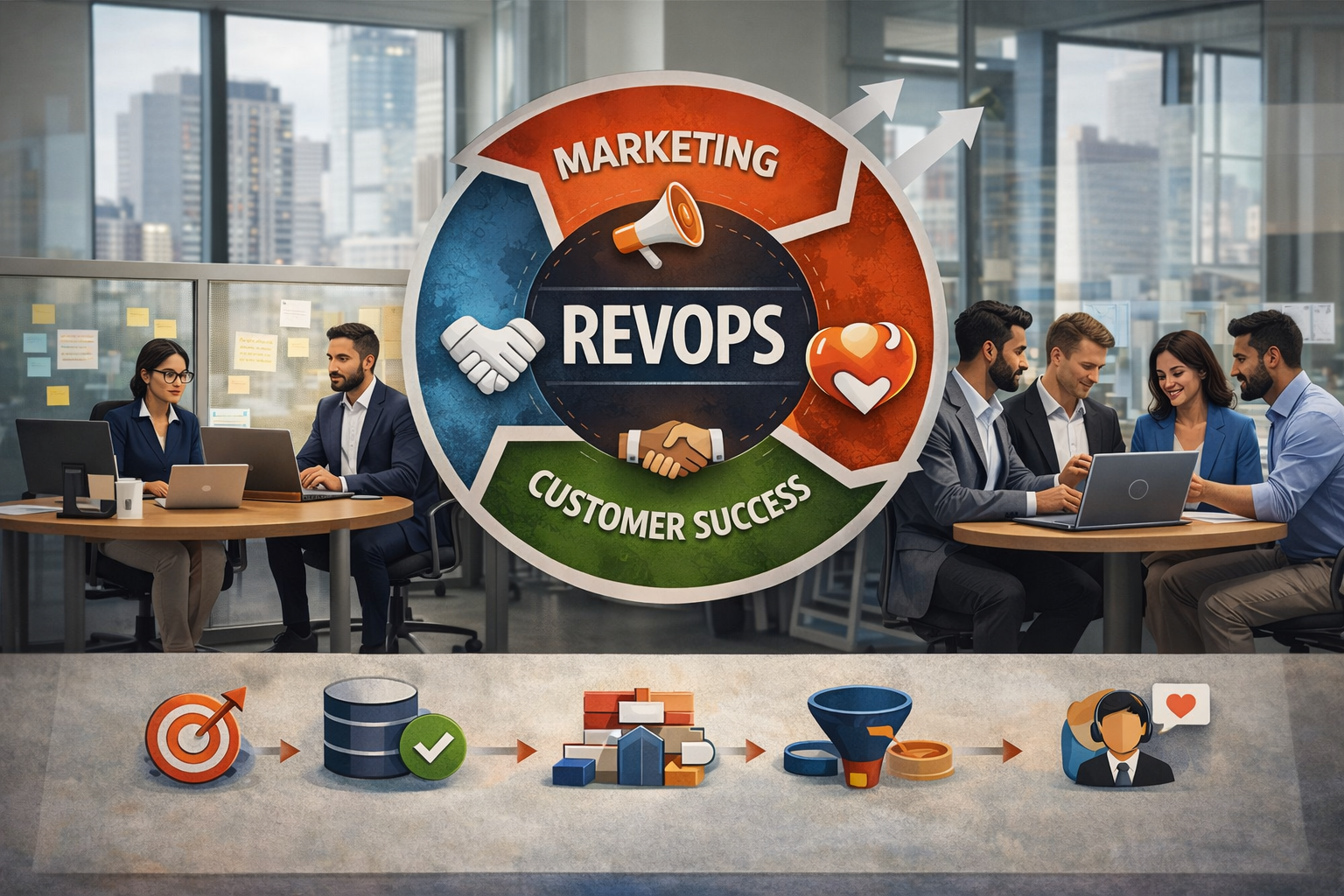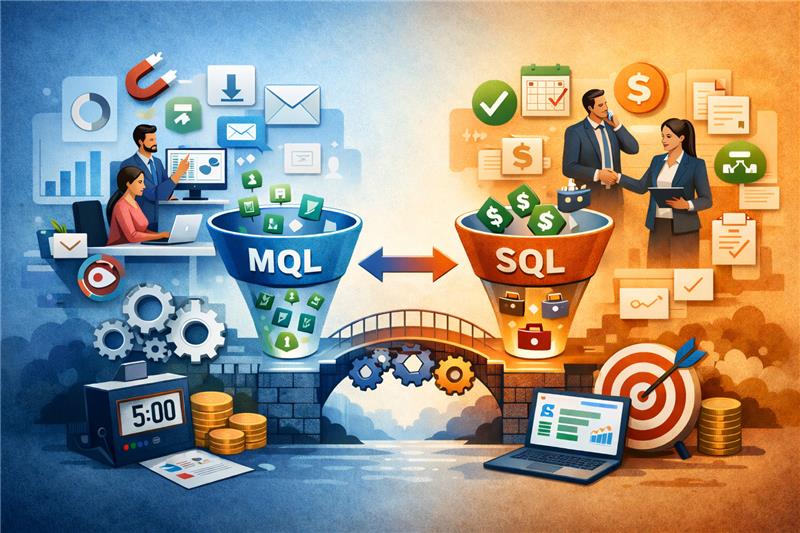

For years, B2B companies treated revenue generation like a relay race. Marketing generated leads, sales chased opportunities, customer success managed retention, and finance tracked the numbers after the fact. Each team operated with its own systems, metrics, and priorities.
The result was predictable: fragmented customer experiences, inconsistent forecasting, duplicated work, and revenue leakage hidden between departments.
Revenue Operations (RevOps) emerged as the answer to this problem. What began as a niche operational function has evolved into one of the most important strategic capabilities in modern B2B organizations. Today, RevOps sits at the center of how companies scale efficiently, align teams, improve customer journeys, and create predictable growth.
In many high-growth organizations, RevOps is no longer optional infrastructure — it is the backbone of B2B growth.
What Is RevOps?
Revenue Operations is the practice of aligning sales, marketing, customer success, and finance under a unified operational strategy focused on revenue growth.
Instead of each department running independently, RevOps creates a centralized system for:
- Data management
- Process optimization
- Technology integration
- Forecasting and analytics
- Revenue planning
- Customer lifecycle management
- Performance measurement
At its core, RevOps ensures every revenue-generating team works from the same data, goals, and workflows.
Rather than optimizing isolated departments, RevOps optimizes the entire revenue engine.
Why Traditional B2B Growth Models Broke Down
The rise of RevOps was driven by growing complexity in B2B sales and customer acquisition.
1. Buyers Became More Independent
Modern B2B buyers conduct extensive research before speaking with sales teams. Customers interact with websites, webinars, content, ads, review platforms, and product demos across multiple channels.
This created fragmented customer journeys that traditional siloed teams struggled to manage.
2. Tech Stacks Exploded
Most B2B companies now rely on dozens of tools:
- CRMs
- Marketing automation platforms
- Sales engagement tools
- Analytics dashboards
- Customer success software
- Billing systems
- Data warehouses
Without centralized operational ownership, these systems often become disconnected, creating inconsistent reporting and poor visibility.
3. Revenue Predictability Became Essential
Investors and leadership teams increasingly demand accurate forecasting and efficient growth.
Companies can no longer afford:
- Unclear pipeline health
- Misaligned KPIs
- Poor attribution
- Inconsistent customer handoffs
- High churn due to operational gaps
RevOps emerged because businesses needed a system capable of managing growth with precision.
The Shift from Department Metrics to Revenue Metrics
One of the biggest transformations RevOps introduced was changing how teams measure success.
Traditionally:
- Marketing focused on leads
- Sales focused on closed deals
- Customer success focused on renewals
- Finance focused on reporting
These isolated metrics often created conflicting incentives.
For example:
- Marketing could deliver large volumes of low-quality leads
- Sales could close poor-fit customers
- Customer success inherited difficult accounts
RevOps shifted the focus toward shared revenue outcomes:
- Pipeline quality
- Customer acquisition cost (CAC)
- Revenue retention
- Lifetime value (LTV)
- Expansion revenue
- Forecast accuracy
- Revenue efficiency
This alignment fundamentally changed how B2B teams collaborate.
RevOps as the Operating System for Growth
Today, RevOps functions like the operating system behind modern B2B companies.
It connects strategy, execution, systems, and analytics into a single framework.
Centralized Data and Visibility
RevOps creates a single source of truth across the business.
This allows leadership teams to answer critical questions quickly:
- Which channels generate the best customers?
- Where are deals getting stuck?
- Which accounts are likely to churn?
- What is the real forecast for next quarter?
- Which customer segments are most profitable?
Without RevOps, these answers often depend on disconnected spreadsheets and conflicting reports.
Process Standardization
High-growth companies cannot scale chaotic processes.
RevOps standardizes:
- Lead routing
- Opportunity management
- Pipeline stages
- Customer onboarding
- Renewal workflows
- Reporting structures
This consistency improves operational efficiency while reducing friction for customers.
Technology Integration
A major responsibility of RevOps is connecting the company’s revenue technology stack.
RevOps teams often manage:
- CRM architecture
- Marketing automation
- Sales enablement tools
- Customer success platforms
- Revenue intelligence systems
- Data synchronization
When systems communicate effectively, teams gain cleaner data and stronger insights.
RevOps and the Rise of PLG + Hybrid Sales Models
The growth of Product-Led Growth (PLG) accelerated the importance of RevOps.
In PLG environments, customers may:
- Discover a product independently
- Start with a free trial
- Upgrade without speaking to sales
- Expand usage over time
- Interact with multiple teams throughout the lifecycle
This creates highly dynamic customer journeys.
RevOps helps unify these touchpoints by connecting product data, customer behavior, sales engagement, and retention metrics.
As B2B companies increasingly adopt hybrid models combining self-service and enterprise sales, RevOps becomes even more essential.
The Strategic Role of RevOps Leaders
RevOps leaders are no longer viewed as back-office operators.
They increasingly influence strategic decisions related to:
- Market expansion
- Pricing models
- Sales capacity planning
- Territory design
- Compensation structures
- Forecasting strategy
- Customer segmentation
- AI and automation adoption
In many organizations, the Head of RevOps now works directly with the CEO, CRO, and CFO.
This reflects a broader shift: operational intelligence has become a competitive advantage.
How RevOps Improves Customer Experience
One of the most overlooked benefits of RevOps is customer experience.
Customers do not care about internal departmental boundaries.
They expect:
- Consistent communication
- Smooth onboarding
- Fast issue resolution
- Personalized engagement
- Seamless renewals
Poor operational alignment creates customer frustration.
Examples include:
- Repeating the same information to multiple teams
- Receiving irrelevant outreach
- Experiencing onboarding delays
- Encountering billing confusion
RevOps reduces these friction points by aligning systems and workflows around the customer journey.
In many ways, RevOps is not just about revenue optimization — it is about creating a more coherent customer experience.
The Role of AI in Modern RevOps
Artificial intelligence is rapidly reshaping RevOps.
Modern RevOps teams use AI to:
- Improve forecasting accuracy
- Detect pipeline risks
- Score leads dynamically
- Automate repetitive workflows
- Identify churn signals
- Generate sales insights
- Optimize pricing recommendations
AI amplifies the effectiveness of RevOps because centralized operational data creates the foundation machine learning systems require.
Companies with fragmented systems often struggle to benefit fully from AI.
Companies with mature RevOps functions are positioned to move faster.
Common Challenges in Building RevOps
Despite its advantages, implementing RevOps is not simple.
Organizational Resistance
Departments accustomed to autonomy may resist centralized processes.
RevOps often requires cultural change, not just technical integration.
Data Quality Problems
Poor CRM hygiene and inconsistent reporting can undermine RevOps initiatives.
Reliable operations depend on clean, standardized data.
Overcomplicated Processes
Some organizations make RevOps too bureaucratic.
The goal is operational clarity and scalability — not unnecessary complexity.
Tool Sprawl
Many companies adopt too many disconnected tools.
Successful RevOps teams prioritize integration and simplicity.
Why RevOps Matters More During Economic Pressure
In uncertain economic environments, efficient growth becomes critical.
Companies can no longer rely solely on aggressive spending to drive revenue.
RevOps helps businesses:
- Improve sales productivity
- Reduce customer acquisition waste
- Increase retention
- Improve forecast confidence
- Optimize revenue efficiency
This is why RevOps adoption often accelerates during periods of tighter budgets and investor scrutiny.
Operational discipline becomes a survival advantage.
The Future of RevOps
RevOps is still evolving.
Over the next decade, the function will likely expand beyond operational coordination into broader business orchestration.
Future RevOps teams may increasingly oversee:
- AI-driven revenue systems
- Real-time customer intelligence
- Predictive expansion modeling
- End-to-end lifecycle automation
- Unified revenue data platforms
The distinction between operations, analytics, and strategic planning may continue to blur.
As B2B buying journeys become more complex, companies will depend even more on centralized operational intelligence.
Read Also: How AI Is Transforming Sales and Marketing Alignment