
A powerful marketing technology stack doesn’t have to come with a six-figure price tag.
For startups, small businesses, and growing marketing teams, the real challenge isn’t finding more tools—it’s choosing the right tools, connecting them effectively, and getting maximum value from every platform.
A high-performing martech stack should help your team attract prospects, understand customer behavior, automate repetitive work, improve conversions, and measure marketing ROI. And you can achieve all of that without paying for dozens of expensive platforms.
Here’s how to build a lean, scalable martech stack on a budget.
1. Start With Your Marketing Goals, Not Your Tools
One of the biggest martech mistakes is buying software before defining the problem it needs to solve.
Instead, begin with your marketing objectives.
Ask:
- Do we need more qualified leads?
- Do we need to improve website conversions?
- Are we struggling to nurture leads?
- Do we need better customer insights?
- Are reporting and attribution taking too much time?
- Which marketing processes could be automated?
Your technology should support your strategy—not become the strategy.
For example, if your primary goal is lead generation, you may need analytics, a CRM, lead-capture forms, email automation, and reporting. If retention is the priority, customer engagement, lifecycle automation, and support tools may matter more.
Build around business outcomes first.
2. Build a Lean Martech Foundation
A practical martech stack typically covers six core functions.
Analytics
You need a reliable way to understand where visitors come from, what they do, and which campaigns generate results.
Start with a free or low-cost web analytics platform and configure it properly before investing in more advanced analytics software.
The goal isn’t to collect every possible data point. It’s to answer useful questions such as:
- Which channels generate qualified traffic?
- Which landing pages convert?
- Where do prospects drop off?
- Which campaigns influence revenue?
CRM
Your CRM should act as the central source of truth for customer and prospect information.
For a small team, a free or entry-level CRM can often provide enough functionality to manage contacts, track deals, segment audiences, and monitor sales activity.
Avoid paying for advanced CRM features until your team actually needs them.
Email Marketing and Automation
Email remains one of the most cost-effective marketing channels, particularly when automation is used effectively.
At minimum, your platform should support:
- Segmentation
- Automated welcome sequences
- Lead nurturing
- Campaign tracking
- Basic personalization
- Unsubscribe and consent management
Start with a few high-value workflows rather than building dozens of complicated automations.
Content and SEO
Your website is often the center of your digital marketing ecosystem.
A lean content stack might include:
- A CMS
- Keyword and SEO research tools
- Content planning tools
- A basic design platform
- A tool for monitoring search performance
You don’t need five different content platforms. You need a repeatable process for researching, creating, publishing, and measuring content.
Conversion Optimization
Traffic has limited value if your website doesn’t convert it.
Use analytics, session behavior, heatmaps, user feedback, and A/B testing where appropriate to identify conversion opportunities.
Prioritize simple improvements first: clearer calls to action, better landing-page messaging, shorter forms, faster pages, and stronger offers.
Reporting
Your reporting layer should bring important marketing data together so the team can make decisions without manually opening ten different platforms.
A simple dashboard can track:
- Website traffic
- Leads
- Conversion rates
- Cost per lead
- Pipeline contribution
- Customer acquisition cost
- Revenue generated by marketing
Keep the dashboard focused on metrics that influence decisions.
3. Use the “Free First, Paid When Proven” Principle
A useful rule for budget-conscious teams is:
Start free. Upgrade when the business case is clear.
Many marketing platforms offer free tiers or inexpensive starter plans. These are often more than sufficient while your marketing processes are still developing.
Upgrade when you encounter a genuine limitation—for example:
- Your contact database has outgrown the free tier.
- You need advanced automation.
- Multiple teams require access.
- You need more sophisticated reporting.
- Manual processes are consuming significant employee time.
- A paid feature can demonstrably improve revenue or efficiency.
Don’t upgrade simply because a premium feature looks impressive.
4. Avoid the “Frankenstack”
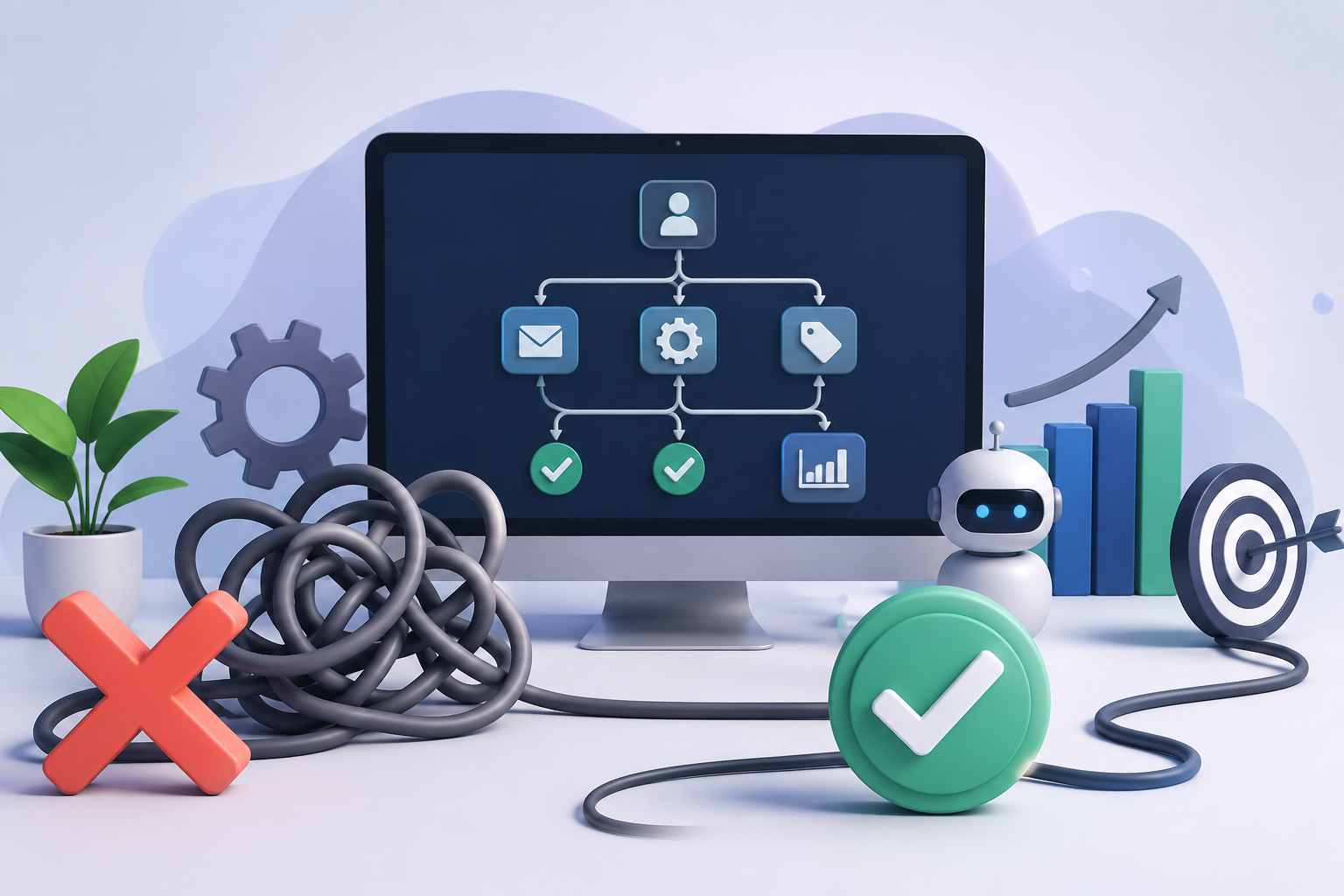
A Frankenstack is a collection of disconnected tools that technically work but create operational chaos.
For example, your marketing team might use one platform for forms, another for email, another for CRM, another for lead scoring, and another for reporting—with data manually transferred between them.
This creates several problems:
- Duplicate customer records
- Inconsistent data
- Broken automations
- Reporting gaps
- More software costs
- More training requirements
Before adding a new tool, ask:
Can an existing platform already solve this problem?
If yes, use the existing platform unless the new tool provides a compelling business advantage.
5. Prioritize Integration Over Feature Count
A smaller number of well-integrated tools can outperform a larger collection of disconnected platforms.
Your ideal stack should allow information to flow smoothly between major systems.
For example:
Website → CRM → Email Automation → Sales → Reporting
A visitor submits a form. Their information enters the CRM. They are placed into an appropriate segment. A relevant nurture sequence begins. Sales can see engagement history. Marketing can measure whether the activity eventually contributed to revenue.
That is much more valuable than simply owning sophisticated software.
6. Automate Repetitive Marketing Tasks
Automation is one of the best ways for small teams to compete with larger organizations.
Look for repetitive processes such as:
- Lead assignment
- Welcome emails
- Follow-up reminders
- Contact segmentation
- Internal notifications
- Campaign reporting
- Data synchronization
- Customer onboarding
- Re-engagement campaigns
Start with processes that happen frequently and follow predictable rules.
A simple automation that saves five hours every week can be more valuable than an advanced AI feature that nobody uses.
7. Don’t Ignore Data Quality
A low-cost martech stack can become expensive if the underlying data is unreliable.
Establish basic data standards early.
Define:
- Required CRM fields
- Naming conventions
- Lead-source definitions
- Lifecycle stages
- Campaign naming conventions
- Duplicate-record rules
- Data ownership
- Consent requirements
Schedule regular data-cleaning exercises.
Remember: bad data produces bad automation and bad reporting.
8. Choose Tools That Can Scale With You
Budget doesn’t mean choosing the cheapest possible software.
The better approach is choosing software that provides good value today without creating unnecessary migration problems tomorrow.
Before adopting a platform, consider:
- Does it integrate with our core systems?
- Can we export our data?
- Will it support our expected growth?
- Is pricing predictable?
- How difficult is it to train new employees?
- Does it have adequate documentation and support?
- Will we actually use its key features?
A cheap tool that you have to replace six months later isn’t necessarily cheap.
9. Measure Martech ROI
Every major tool should have a purpose and a success metric.
Instead of asking, “How much does this platform cost?” ask:
“What value does this platform create?”
For example, consider the annual software cost alongside the time saved through automation, additional revenue generated, improved conversion rates, and other measurable benefits.
The exact calculation will vary by business, but the principle is universal: evaluate technology based on outcomes rather than features.
Also consider the hidden cost of software: implementation, training, maintenance, integrations, and employee time.
10. Review Your Stack Regularly
Your martech stack should evolve as your business evolves.
Every six months, conduct a simple audit.
Keep: Tools that are heavily used and clearly deliver value.
Consolidate: Tools whose functionality overlaps.
Upgrade: Platforms that are creating genuine bottlenecks.
Replace: Tools that consistently underperform.
Remove: Software nobody uses.
This exercise can uncover substantial savings. Many companies continue paying for subscriptions simply because nobody has taken ownership of the software portfolio.
The Golden Rule: Simplicity Wins
A high-performing martech stack isn’t the one with the most tools.
It’s the one where:
- Data moves reliably.
- Teams understand how the systems work.
- Automation eliminates repetitive work.
- Marketing activities can be measured.
- Customers receive relevant experiences.
- Software costs remain proportional to business value.
For a small or growing organization, simplicity is a competitive advantage.
Start with the essentials. Use free tiers where appropriate. Integrate before you expand. Automate repetitive work. Measure ROI. And remove anything that isn’t delivering value.
The result is a martech stack that is not only affordable today, but also capable of supporting tomorrow’s growth.
Read Also: Integration Best Practices for Marketing Technology Platforms