
In today’s competitive digital landscape, LinkedIn has become one of the most powerful platforms for Business-to-Business (B2B) marketing. Unlike traditional social media platforms, LinkedIn focuses on professional networking, industry insights, and business relationships, making it an ideal channel for companies looking to connect with decision-makers, generate qualified leads, and build brand authority.
However, simply creating a LinkedIn company page and posting occasionally is not enough. To achieve meaningful results, B2B companies need a well-defined LinkedIn marketing strategy that combines valuable content, audience targeting, relationship building, and performance measurement.
In this blog, we’ll explore effective LinkedIn marketing strategies that can help B2B companies strengthen their online presence, attract potential customers, and drive sustainable business growth.
1. Optimize Your LinkedIn Company Page
Your LinkedIn company page is often the first impression potential customers have of your business. A professional and informative page helps establish credibility and communicates your brand’s value.
Key optimization tips:
- Write a compelling company description: Clearly explain what your business does, whom you serve, and how you solve customer problems.
- Use professional branding: Add a high-quality company logo and banner that reflect your brand identity.
- Include relevant keywords: Use industry-specific terms naturally in your company description and specialties.
- Add a clear call to action: Direct visitors to your website, product pages, service offerings, or relevant resources.
- Keep company information updated: Ensure your website, contact details, and business information are accurate.
An optimized LinkedIn page creates a strong foundation for your marketing efforts and helps prospects understand why they should engage with your brand.
2. Define Your Target Audience
Effective B2B marketing begins with understanding your ideal customers. Without a clearly defined audience, even high-quality content can fail to generate meaningful engagement or leads.
Start by identifying your ideal customer profile (ICP) and buyer personas.
Consider factors such as:
- Industry and company size
- Job titles and seniority levels
- Geographic location
- Business challenges and pain points
- Purchasing authority and decision-making responsibilities
For example, a SaaS company selling marketing automation software might target marketing managers, demand generation leaders, and chief marketing officers at mid-sized and enterprise businesses.
Understanding your audience helps you create relevant content, personalize outreach, and focus your marketing resources on prospects who are more likely to convert.
3. Create Valuable and Educational Content
Content marketing is a central component of a successful LinkedIn strategy. B2B buyers often research potential solutions before contacting a sales representative. By sharing useful insights, your company can build trust and influence purchasing decisions.
Instead of focusing exclusively on promotional posts, create content that addresses your audience’s real business challenges.
Content formats to consider:
- Industry insights: Share emerging trends, market developments, and expert perspectives.
- Educational posts: Explain practical solutions to common industry problems.
- Case studies: Demonstrate how your products or services have helped customers achieve measurable results.
- Infographics: Present complex information in a visually engaging format.
- Document posts and carousels: Break down frameworks, processes, checklists, and actionable tips.
- Short videos: Share product demonstrations, customer stories, and expert advice.
- Polls and discussions: Encourage your audience to share opinions and experiences.
For example, a cybersecurity company could publish a post titled “5 Cybersecurity Risks Every Growing Business Should Address.” Such content provides immediate value while positioning the company as a knowledgeable industry resource.
The goal is to educate first, build trust consistently, and introduce your solution when it is relevant.
4. Build a Consistent LinkedIn Content Calendar
Consistency helps your brand maintain visibility and develop stronger relationships with its audience. An organized content calendar ensures that your LinkedIn activity supports your broader marketing objectives.
A practical starting point is to publish three to five high-quality posts per week, adjusting the frequency according to your team’s resources and audience response.
Here is an example of a weekly LinkedIn content calendar:
- Monday: Share industry insights to build authority.
- Tuesday: Publish educational tips to provide value.
- Wednesday: Highlight a case study or customer success story to build trust.
- Thursday: Share employee or leadership perspectives to humanize your brand.
- Friday: Post a question, poll, or discussion topic to encourage engagement.
Use this schedule as a starting point rather than a fixed rule. Monitor engagement and lead quality to determine what works best for your audience.
A balanced content strategy should combine educational, engaging, and promotional content without overwhelming followers with sales messages.
5. Leverage LinkedIn Employee Advocacy
Your employees can be valuable ambassadors for your brand. When team members share company updates, professional insights, and original perspectives, they can help expand your reach and make your brand feel more authentic.
Employee advocacy is particularly useful for B2B companies because professional relationships and personal credibility often influence purchasing decisions.
How to encourage employee advocacy:
- Share company news and relevant industry insights with your team.
- Encourage employees to add their own opinions when sharing content.
- Help subject-matter experts publish educational posts.
- Highlight employee achievements and professional expertise.
- Make it easy for employees to participate without requiring identical or scripted posts.
Leadership involvement is especially valuable. When founders, executives, and technical experts share meaningful insights, they can strengthen brand credibility and create conversations with relevant decision-makers.
Remember that employee advocacy should be voluntary and authentic. Genuine perspectives are more valuable than repetitive, copy-and-paste promotional messages.
6. Use LinkedIn Thought Leadership to Build Trust
In B2B markets, buyers often evaluate a company’s expertise before considering its products or services. Thought leadership allows your organization to demonstrate that expertise through original ideas, informed opinions, and practical guidance.
Encourage founders, executives, consultants, and subject-matter experts to share their knowledge on LinkedIn.
Effective thought leadership topics include:
- Lessons learned from real business challenges
- Predictions about industry developments
- Common mistakes businesses should avoid
- Practical frameworks for improving business performance
- Insights from customer projects and professional experience
- Opinions on emerging technologies and changing market needs
For example, a digital transformation consultancy could publish a post explaining why technology implementations fail and how businesses can improve adoption.
The most effective thought leadership is specific, evidence-based, and useful. Instead of repeating widely available advice, share original experiences and perspectives that help your audience make better decisions.
7. Use LinkedIn Ads for Targeted Lead Generation
Organic content helps build relationships over time, while LinkedIn advertising can help B2B companies reach specific professional audiences at scale.
LinkedIn Ads offers targeting options that can include job titles, company attributes, industries, seniority, and professional interests, depending on campaign settings and availability.
Popular advertising formats include:
- Sponsored Content: Promote posts directly in the LinkedIn feed.
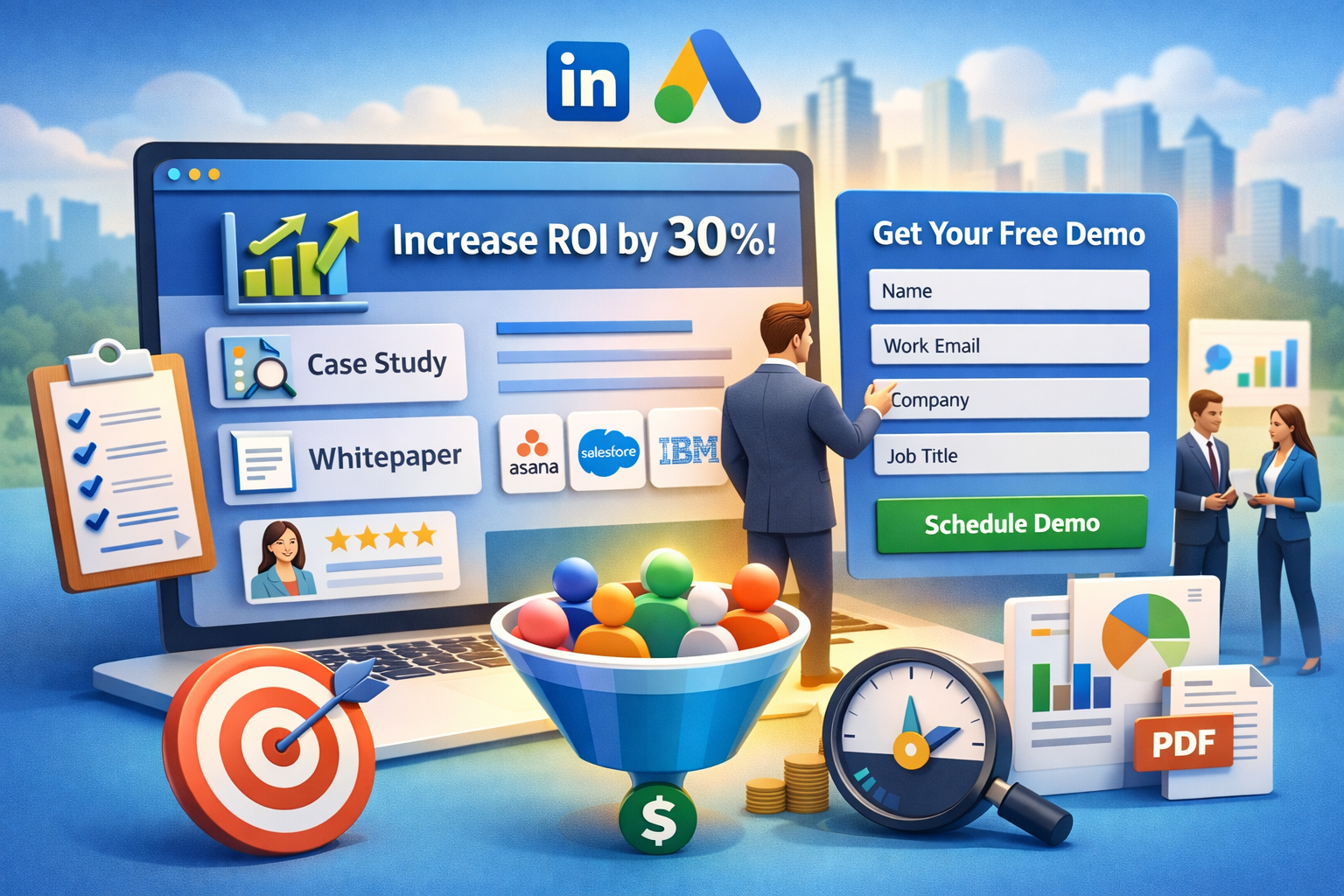
- Lead Gen Forms: Collect prospect information through prefilled forms within LinkedIn.
- Message Ads and Conversation Ads: Deliver targeted messages where these formats are available.
- Document Ads: Promote useful documents and resources.
- Video Ads: Communicate product benefits, customer stories, and brand messages through video.
Best practices for LinkedIn advertising:
- Define a specific campaign objective before launching.
- Target a relevant audience rather than the broadest possible audience.
- Offer something valuable, such as an industry report, webinar, consultation, or product demonstration.
- Use clear messaging that addresses a specific customer challenge.
- Test different creative assets, headlines, and calls to action.
- Evaluate lead quality and conversions, not just clicks and impressions.
LinkedIn advertising can be more expensive than some other digital channels, so businesses should evaluate campaign performance against customer acquisition costs, sales opportunities, and revenue potential.
8. Generate Leads Through Relationship-Based Outreach
LinkedIn is not just a publishing platform; it is also a professional networking environment. B2B companies can use it to identify relevant prospects and initiate meaningful business conversations.
However, effective outreach should focus on relevance and relationship building rather than aggressive selling.
A practical LinkedIn outreach process:
Step 1: Research your prospects. Review their roles, company updates, interests, and potential business challenges.
Step 2: Personalize your connection request. Explain why connecting could be relevant to both parties.
Step 3: Engage before pitching. Interact thoughtfully with their posts or share useful resources when appropriate.
Step 4: Start a relevant conversation. Ask a meaningful question or discuss a challenge related to their business.
Step 5: Introduce your solution when appropriate. If the prospect expresses interest, explain how your product or service could help.
For example, instead of sending a generic message promoting your services, you could reference a prospect’s recent discussion about improving sales productivity and share a useful resource related to that challenge.
Avoid automated spam, misleading personalization, and repeated unsolicited pitches. Sustainable lead generation depends on trust and relevance.
9. Use LinkedIn Groups and Professional Communities
LinkedIn Groups and relevant professional communities can provide opportunities to understand industry challenges, participate in discussions, and establish your expertise.
Rather than treating groups as places to distribute promotional links, focus on contributing useful information.
You can:
- Answer questions related to your industry.
- Share practical recommendations and resources.
- Participate in discussions about emerging trends.
- Identify recurring challenges among potential customers.
- Use community insights to improve your content strategy.
Not every group will generate leads directly. Evaluate communities based on their relevance, discussion quality, and opportunities to build genuine professional relationships.
10. Share Customer Success Stories and Case Studies
B2B purchasing decisions often involve multiple stakeholders and a careful evaluation of risk. Customer success stories can help prospective buyers understand how your solution works in real business situations.
A compelling case study should explain:
- The challenge: What problem was the customer experiencing?
- The solution: How did your company address the problem?
- The implementation: What steps or strategies were involved?
- The results: What measurable improvements did the customer achieve?
- The takeaway: What can other businesses learn from the experience?
Whenever possible, use verified metrics such as reduced processing time, improved conversion rates, cost savings, or increased operational efficiency.
For example, a B2B software company could publish a case study explaining how a customer streamlined its reporting workflow and reduced manual work.
Always obtain the appropriate customer approval before publishing identifiable information or confidential results.
11. Use LinkedIn Analytics to Measure Performance
A successful LinkedIn marketing strategy requires ongoing measurement and optimization. Tracking the right metrics helps you understand which activities contribute to brand awareness, engagement, and revenue.
Important metrics include:
- Impressions and reach: Measure content visibility.
- Engagement rate: Understand how audiences interact with your content.
- Follower growth: Track the development of your LinkedIn audience.
- Link click-through rate: Measure interest in your linked resources.
- Leads generated: Track prospects acquired through marketing.
- Cost per lead: Evaluate advertising efficiency.
- Lead-to-opportunity rate: Assess lead quality and sales relevance.
- Customer acquisition cost: Measure the cost of acquiring customers.
- Marketing-sourced revenue: Understand the revenue associated with marketing efforts.
Use LinkedIn analytics alongside website analytics, CRM data, and campaign tracking to understand the customer journey beyond the initial interaction.
For paid campaigns, assess whether leads become qualified opportunities and customers. A campaign that generates fewer leads but more valuable sales opportunities may outperform one that produces a large volume of low-quality contacts.
12. Integrate LinkedIn With Your Overall B2B Marketing Strategy
LinkedIn works best when it complements your other marketing activities rather than operating in isolation.
Integrate your LinkedIn marketing efforts with:
- Email marketing: Nurture interested prospects with relevant resources and updates.
- Content marketing: Repurpose blog articles, research reports, webinars, and industry insights into LinkedIn posts.
- Search engine optimization (SEO): Connect LinkedIn content with useful resources on your website.
- Account-based marketing (ABM): Coordinate content and outreach for selected high-value companies.
- Sales enablement: Share case studies, product explainers, and customer success stories with sales teams.
- Webinars and events: Promote educational sessions and follow up with interested participants.
This integrated approach helps create a more consistent experience for potential customers and allows marketing and sales teams to work toward shared business objectives.
13. Common LinkedIn Marketing Mistakes to Avoid
Even well-planned campaigns can underperform when businesses overlook important fundamentals.
Avoid these common mistakes:
- Posting only promotional content.
- Targeting an audience that is too broad.
- Ignoring comments and messages.
- Sending generic connection requests and sales pitches.
- Publishing inconsistently.
- Measuring success only through likes and impressions.
- Running paid campaigns without conversion tracking.
- Using unverified claims or customer results.
- Expecting immediate sales from every post.
LinkedIn marketing is a long-term process. Consistent value creation, meaningful engagement, and data-driven improvements are more sustainable than short-term tactics focused only on visibility.
14. A Practical 30-Day LinkedIn Marketing Action Plan
B2B companies can begin improving their LinkedIn presence with a focused 30-day plan.
Week 1: Foundation and Strategy
- Optimize your company page.
- Define your ideal customer profile and buyer personas.
- Review competitors and industry conversations.
- Set measurable marketing objectives.
Week 2: Content Creation
- Develop a content calendar.
- Publish educational and industry-focused posts.
- Share one customer success story or case study.
- Encourage relevant employee and leadership participation.
Week 3: Engagement and Lead Generation
- Identify relevant decision-makers and target accounts.
- Participate in industry discussions.
- Engage thoughtfully with prospects’ content.
- Test a relevant lead magnet or outreach approach.
Week 4: Measurement and Optimization
- Review content performance and audience engagement.
- Analyze website traffic and lead quality.
- Assess advertising results if paid campaigns are running.
- Identify the best-performing topics and formats.
- Refine the next month’s strategy based on the findings.
At the end of 30 days, evaluate progress against your initial objectives and establish realistic targets for the next quarter.
Read Also: Understanding the Modern B2B Buyer Journey: A Complete Guide for Marketers