
In today’s data-driven marketing environment, CMOs are expected to do more than generate awareness and leads. They need to demonstrate how marketing contributes to revenue, customer growth, and long-term business performance.
That is where marketing analytics KPIs become essential. The right metrics help CMOs understand what is working, identify inefficient spending, optimize campaigns, and make confident strategic decisions.
But tracking too many metrics can be just as problematic as tracking too few. The goal is to focus on KPIs that connect marketing activity to meaningful business outcomes.
1. Marketing-Generated Revenue
One of the most important KPIs for any CMO is the amount of revenue directly influenced or generated by marketing.
This metric helps answer a fundamental question:
How much business value is marketing creating?
Marketing-generated revenue can be measured by tracking opportunities and customers that originated from marketing campaigns, content, paid advertising, events, email programs, or other initiatives.
For CMOs, this KPI provides a stronger business perspective than simply reporting impressions, clicks, or leads.
2. Customer Acquisition Cost (CAC)
Customer Acquisition Cost (CAC) measures how much a company spends, on average, to acquire a new customer.
A basic formula is:
CAC = Total Sales & Marketing Costs ÷ Number of New Customers Acquired
For example, if a company spends $100,000 on sales and marketing and acquires 500 new customers, its CAC is $200.
Tracking CAC by channel can reveal which marketing investments are efficient and which require optimization.
3. Customer Lifetime Value (CLV)
CAC becomes much more useful when viewed alongside Customer Lifetime Value (CLV).
CLV estimates the total revenue or profit a customer is expected to generate throughout their relationship with the company.
A healthy CLV-to-CAC ratio indicates that customer acquisition is generating sufficient long-term value.
For example, if acquiring a customer costs $200 and that customer generates $1,000 in expected lifetime value, the economics are considerably stronger than a scenario where lifetime value is only $250.
CMOs should monitor this relationship by customer segment, product, geography, and acquisition channel.
4. Marketing ROI
Marketing ROI measures the financial return generated by marketing investment.
A simplified formula is:
Marketing ROI = (Revenue Attributed to Marketing − Marketing Investment) ÷ Marketing Investment × 100
ROI allows CMOs to compare campaigns and channels based on financial outcomes rather than activity levels.
However, attribution can be complicated, particularly when customers interact with multiple channels before converting. CMOs should therefore combine ROI with attribution models and broader customer-journey analysis.
5. Marketing-Sourced Pipeline
For B2B organizations, marketing-sourced pipeline is a critical KPI.
It measures the value of sales opportunities that originated from marketing activities.
Tracking this metric helps marketing leaders demonstrate their contribution to the sales pipeline and identify campaigns that generate high-quality opportunities.
It is particularly useful when paired with:
- Pipeline conversion rate
- Average deal size
- Sales cycle length
- Win rate
- Revenue generated
6. Lead-to-Customer Conversion Rate
Generating thousands of leads does not necessarily mean marketing is performing well.
The lead-to-customer conversion rate measures how many leads ultimately become paying customers.
Conversion Rate = Number of Customers ÷ Number of Leads × 100
A low conversion rate may indicate problems with lead quality, targeting, messaging, sales follow-up, or the customer journey.
For this reason, CMOs should analyze conversion rates at multiple stages rather than relying solely on top-of-funnel lead volume.
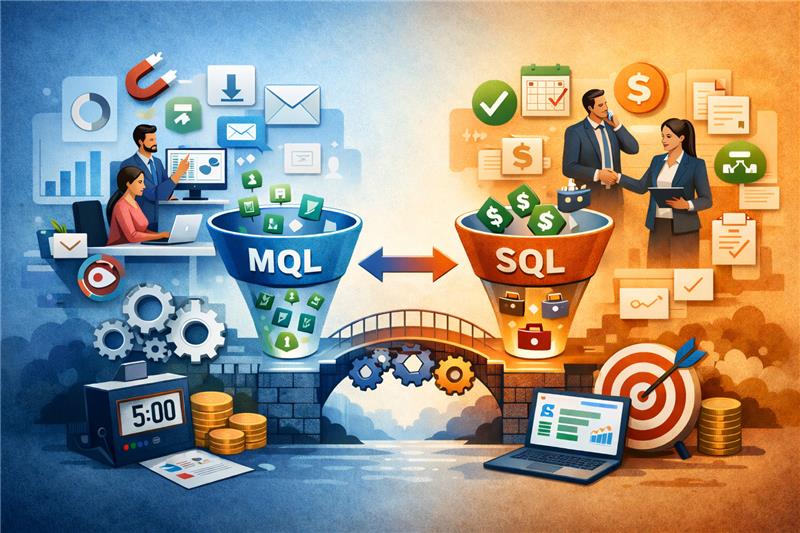
7. Marketing Qualified Lead (MQL) to Sales Qualified Lead (SQL) Conversion
For organizations using MQL and SQL stages, this KPI measures how effectively marketing-generated leads progress toward sales readiness.
A declining MQL-to-SQL rate could indicate that campaigns are attracting the wrong audience or that qualification criteria need to be refined.
It can also highlight alignment issues between marketing and sales.
8. Customer Retention Rate
Marketing does not stop when a prospect becomes a customer.
Retention is increasingly important because retaining existing customers can be more efficient than continuously acquiring new ones.
Customer Retention Rate measures the percentage of customers a business retains over a specific period.
CMOs can use retention data to evaluate the effectiveness of customer marketing, lifecycle campaigns, loyalty initiatives, onboarding programs, and engagement strategies.
9. Customer Churn Rate
The opposite side of retention is customer churn.
Churn measures the percentage of customers who stop using a product or service during a defined period.
Monitoring churn helps marketing leaders identify potential issues with customer experience, positioning, expectations, product adoption, or engagement.
For subscription businesses in particular, churn should be a core executive-level KPI.
10. Website Conversion Rate
Website traffic alone provides limited insight into business performance.
Website conversion rate measures the percentage of visitors who complete a desired action, such as:
- Requesting a demo
- Completing a purchase
- Filling out a contact form
- Signing up for a newsletter
- Downloading a resource
- Starting a free trial
CMOs should evaluate conversion rates across traffic sources, landing pages, devices, audience segments, and campaigns to identify optimization opportunities.
11. Cost per Lead (CPL)
Cost per Lead measures the amount spent to generate each lead.
CPL = Campaign or Channel Spend ÷ Number of Leads Generated
CPL is useful for evaluating paid campaigns and comparing acquisition channels.
However, a low CPL does not automatically mean better performance. A channel generating inexpensive but low-quality leads may ultimately produce less revenue than a channel with a higher CPL.
That is why CPL should always be evaluated alongside lead quality and downstream conversion.
12. Customer Engagement Metrics
Engagement metrics help CMOs understand how audiences interact with marketing content and campaigns.
Depending on the channel, these may include:
- Email open and click-through rates
- Content engagement
- Video completion rates
- Social engagement
- Website engagement
- App activity
- Repeat visits
These metrics are most valuable when connected to subsequent actions, such as conversions, pipeline creation, or customer retention.
13. Share of Voice
Share of Voice (SOV) measures how visible a brand is compared with competitors within a specific market or channel.
It can include visibility across:
- Search results
- Social media
- Digital advertising
- Online publications
- Industry conversations
Share of voice is particularly useful for CMOs focused on brand growth and competitive positioning.
14. Brand Awareness and Brand Health
Not every marketing outcome happens immediately.
Brand awareness metrics help CMOs measure whether target audiences recognize and remember the brand.
Useful measures can include:
- Unaided brand awareness
- Aided brand awareness
- Brand consideration
- Brand preference
- Brand recall
- Brand sentiment
These KPIs complement revenue-focused metrics by showing whether marketing is building long-term brand equity.
15. Marketing Attribution
Modern customer journeys often involve multiple touchpoints.
A prospect might discover a brand through search, interact with social content, download a report, attend a webinar, and eventually convert after speaking with sales.
Marketing attribution helps determine which interactions contributed to the conversion.
CMOs can evaluate models such as:
- First-touch attribution
- Last-touch attribution
- Linear attribution
- Position-based attribution
- Data-driven attribution
No single attribution model is perfect. The objective is to develop a consistent measurement framework that supports better investment decisions.
16. Pipeline Velocity
Pipeline velocity measures how quickly qualified opportunities move through the sales pipeline.
A simplified approach considers:
Number of Opportunities × Average Deal Value × Win Rate ÷ Sales Cycle Length
Marketing can influence pipeline velocity by improving lead quality, nurturing prospects, strengthening content, and accelerating movement between funnel stages.
A faster pipeline can improve revenue predictability and overall growth efficiency.
17. Return on Ad Spend (ROAS)
For paid advertising, Return on Ad Spend (ROAS) is a widely used performance metric.
ROAS = Revenue Attributed to Advertising ÷ Advertising Spend
For example, spending $10,000 and generating $50,000 in attributed revenue produces a 5× ROAS.
CMOs should avoid viewing ROAS in isolation. A campaign can have strong ROAS but still have limited strategic value if it cannot scale or if it primarily captures existing demand.
18. Marketing Contribution to Customer Growth
Ultimately, CMOs should connect marketing analytics to the company’s broader growth strategy.
This means looking beyond individual campaign metrics and asking:
- How many new customers did marketing help create?
- Which channels produce the most valuable customers?
- How efficiently are we acquiring those customers?
- How much revenue comes from marketing-influenced opportunities?
- Are customers staying and expanding?
- Is the brand becoming stronger over time?