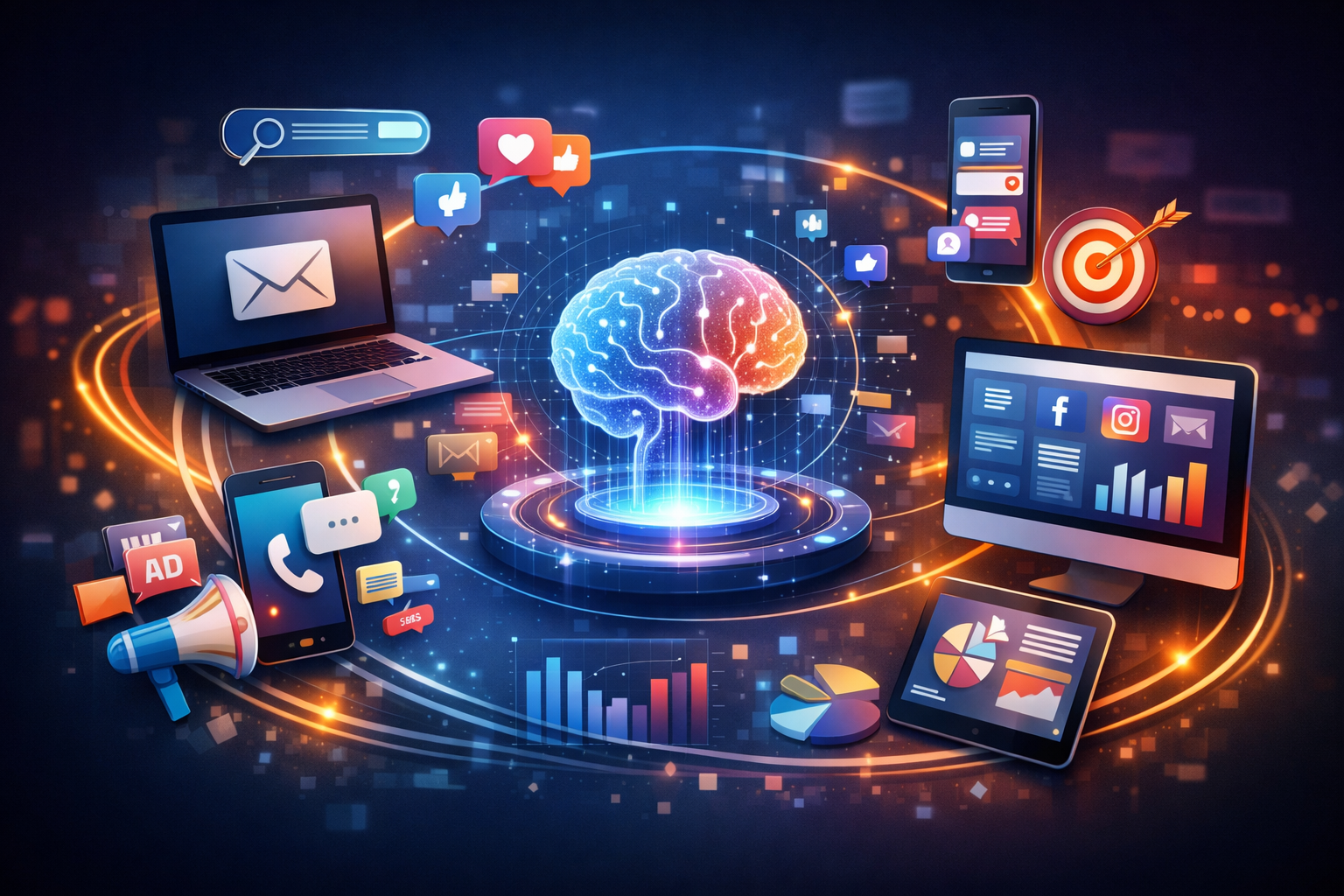

Marketing attribution has always been about answering a deceptively simple question: what actually drives performance? As customer journeys have grown more complex—spanning devices, channels, and timeframes—traditional attribution models have struggled to keep pace. At the same time, AI analytics has emerged as a powerful force, capable of processing vast datasets, detecting hidden patterns, and predicting future outcomes.
When attribution models are tied into AI-driven analytics and predictive performance frameworks, they evolve from backward-looking reporting tools into forward-looking decision engines. This blog explores how attribution models work, where they fall short, and how AI transforms attribution into a predictive, optimization-focused capability.
A Brief Overview of Attribution Models
Attribution models assign credit for conversions or revenue across marketing touchpoints. Historically, these models have fallen into three main categories:
- Single-Touch Models
- First-touch attribution assigns all credit to the first interaction.
- Last-touch attribution assigns all credit to the final interaction before conversion.
These models are simple and easy to explain, but they oversimplify the customer journey and often bias decision-making toward specific channels.
- Rule-Based Multi-Touch Models
- Linear attribution distributes credit evenly across touchpoints.
- Time-decay attribution weights touchpoints closer to conversion more heavily.
- Position-based (U-shaped or W-shaped) models emphasize key milestones such as first interaction, lead creation, and conversion.
Rule-based models improve fairness but still rely on assumptions that may not reflect real-world behavior.
- Algorithmic / Data-Driven Attribution
Algorithmic models use statistical methods to infer the incremental impact of each touchpoint based on observed data. These approaches mark the transition from static rules to adaptive, data-informed attribution.
This is where AI analytics meaningfully enters the picture.
The Limitations of Traditional Attribution
Even advanced rule-based and algorithmic attribution models face persistent challenges:
- Correlation vs. causation: Many models infer impact from patterns without proving true incrementality.
- Data fragmentation: Customer data is often siloed across platforms, devices, and identity systems.
- Lagging indicators: Attribution typically explains past performance but offers limited guidance on future outcomes.
- Static assumptions: Customer behavior changes faster than most attribution rules are updated.
These limitations reduce attribution’s value as a strategic planning tool—unless it is augmented by AI.
How AI Analytics Transforms Attribution
AI analytics enhances attribution by introducing learning, adaptability, and prediction into the measurement process.
- Advanced Pattern Recognition
Machine learning models can analyze millions of journeys simultaneously, identifying non-obvious sequences, interaction effects, and channel synergies. For example, AI can detect that certain upper-funnel channels only perform when paired with specific mid-funnel touches.
- Dynamic Weighting
Rather than fixed rules, AI-powered attribution continuously adjusts weights based on new data. If customer behavior shifts due to seasonality, economic conditions, or platform changes, the model adapts in near real time.
- Probabilistic and Causal Modeling
Modern AI approaches incorporate:
- Markov chains to measure removal effects of touchpoints
- Bayesian models to quantify uncertainty
- Causal inference techniques to estimate true incremental lift
These methods move attribution closer to understanding why conversions happen, not just where they happen.
From Attribution to Predictive Performance
The real breakthrough occurs when attribution outputs feed predictive performance models.
Predicting Channel Contribution
AI can use attribution signals as features in forecasting models to predict:
- Expected ROI by channel
- Marginal returns on incremental spend
- Saturation points and diminishing returns
This allows marketers to simulate scenarios such as: What happens if we shift 10% of budget from paid search to connected TV?
Budget Optimization and Scenario Planning
By combining attribution data with predictive analytics, organizations can:
- Optimize budget allocation before spend occurs
- Run counterfactual simulations across channels
- Align marketing investment with revenue and lifetime value goals
Attribution becomes an input to planning, not just a post-campaign report.
Personalization and Journey Orchestration
Predictive attribution models can operate at the user or cohort level, informing:
- Next-best-action recommendations
- Personalized messaging sequences
- Channel selection based on predicted conversion probability
This closes the loop between measurement, prediction, and activation.
Organizational and Data Requirements
To successfully tie attribution models into AI analytics, several foundations are critical:
Unified Data Infrastructure
- Consistent customer identity resolution
- Integrated online and offline data
- Clean, well-governed event-level datasets
Model Transparency and Trust
AI-driven attribution must balance sophistication with explainability. Stakeholders need to understand why a model recommends reallocating spend, even if the underlying math is complex.
Continuous Experimentation
Predictive attribution models should be validated through:
- Incrementality testing
- Geo-based experiments
- Holdout groups
This ensures AI insights translate into real-world performance gains.
The Future of Attribution and AI
As privacy regulations tighten and third-party identifiers decline, AI-powered attribution will rely more heavily on:
- First-party data
- Modeled conversions
- Privacy-preserving machine learning techniques
Attribution will increasingly converge with marketing mix modeling (MMM), real-time analytics, and AI agents capable of autonomously adjusting campaigns based on predicted outcomes.
In this future state, attribution is no longer a static model—it is a living system that learns, predicts, and optimizes continuously.
Read also: Breaking Silos with Unified Customer Data Platforms (CDPs) and Real-Time Analytics