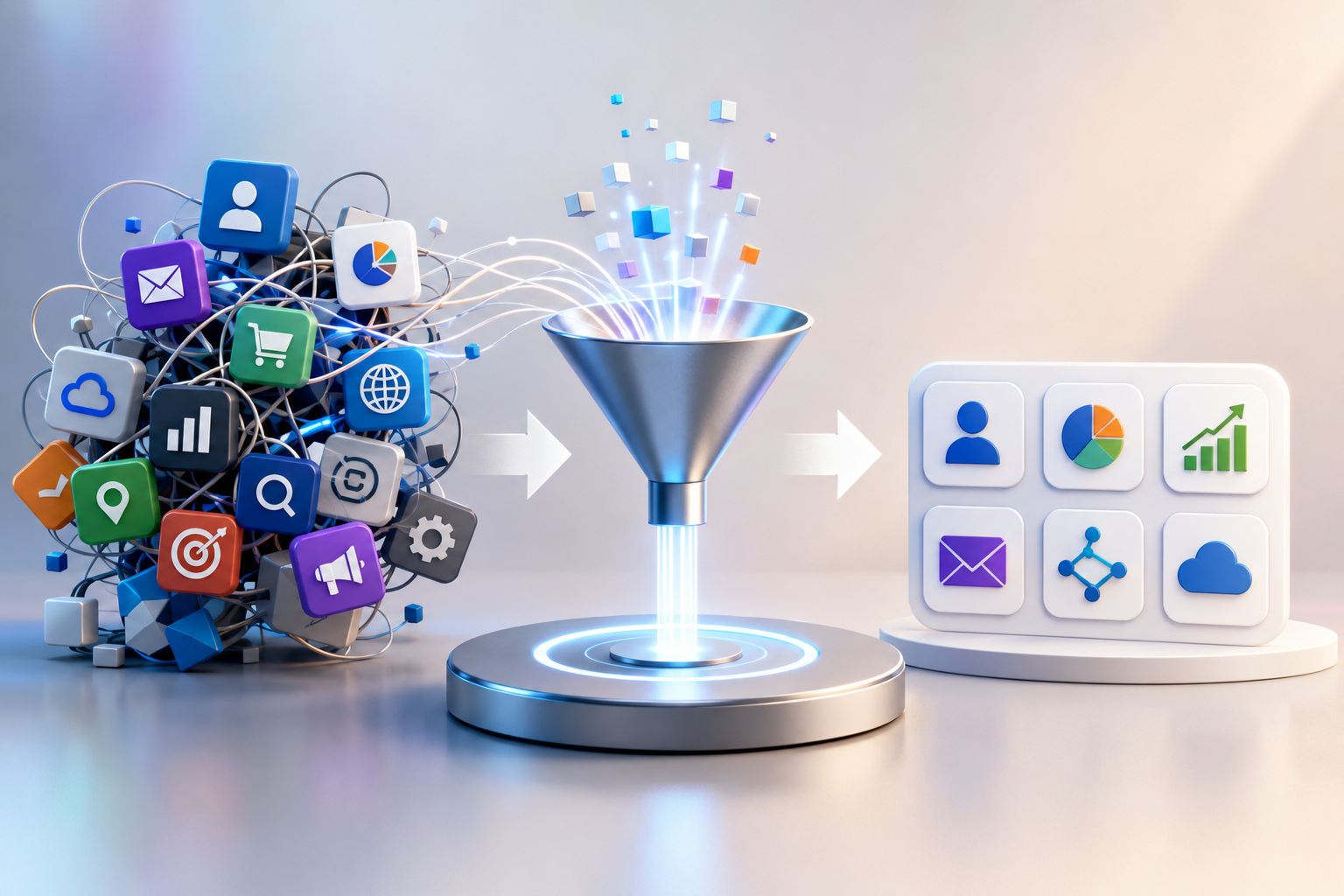

For years, B2B marketing technology stacks grew outward — adding tools for automation, analytics, ABM, personalization, and customer experience. The result? Powerful capabilities, but fragmented data.
Today, leading B2B organizations are flipping the model.
Instead of tools at the center, data is now the foundation. And at the heart of this data-first approach sits the cloud data warehouse.
This shift is redefining how modern martech stacks are designed, governed, and scaled.
What Is a Data-First Architecture?
A data-first architecture prioritizes centralized, high-quality, accessible data before tools, channels, or campaigns.
Rather than each martech platform storing and owning its own data, information flows into a single source of truth — typically a cloud data warehouse — which then powers all downstream tools.
Key Characteristics:
- Centralized customer, account, and engagement data
- Separation of data layer and activation layer
- Real-time or near-real-time data availability
- Tool-agnostic and future-proof design
In this model, tools become interchangeable — data does not.
Why Cloud Data Warehouses Are Becoming the Core Hub
Cloud data warehouses like Snowflake, BigQuery, Redshift, and Databricks were once owned primarily by analytics teams. Today, they’re becoming the operational backbone of B2B marketing.
1. Unified Customer & Account View
B2B buyer journeys are complex:
- Multiple stakeholders
- Long sales cycles
- Interactions across dozens of touchpoints
A cloud warehouse enables:
- Account-level aggregation (critical for ABM)
- Cross-channel identity resolution
- Sales, marketing, and product data in one place
This creates a true 360° account and buyer view — not just channel-specific snapshots.
2. Breaking Free from Tool Lock-In
Traditional stacks rely heavily on “all-in-one” platforms to manage data and activation. The downside?
- Rigid data models
- Limited customization
- High switching costs
With a warehouse-centric model:
- Tools plug into the data, not the other way around
- You can replace or add tools without re-architecting everything
- Innovation accelerates without vendor dependency
This is especially valuable as AI-native martech tools continue to emerge rapidly.
3. Powering AI, Analytics, and Advanced Measurement
AI and machine learning are only as good as the data feeding them.
Cloud data warehouses support:
- Predictive lead and account scoring
- Intent modeling and propensity analysis
- Multi-touch attribution and revenue analytics
- AI-driven personalization across channels
Instead of siloed reporting, teams gain revenue-grade intelligence.
4. Real-Time Activation Across the Stack
Modern data pipelines allow near-real-time syncing between warehouses and activation tools such as:
- Marketing automation platforms
- Ad platforms
- ABM tools
- Personalization engines
- CRM systems
This enables:
- Trigger-based campaigns
- Dynamic account targeting
- Behavioral personalization at scale
Marketing moves from batch campaigns to signal-driven engagement.
The Role of CDPs in a Data-First Stack
In a data-first architecture, CDPs evolve rather than disappear.
Instead of being the system of record, CDPs act as:
- Data orchestration layers
- Identity resolution engines
- Activation and audience-building interfaces
Many organizations now adopt “warehouse-native CDPs”, built directly on top of cloud data warehouses, combining governance with flexibility.
Benefits for B2B Marketing Teams
🔹 Better Alignment with Sales & RevOps
Shared data models reduce disputes over metrics, attribution, and pipeline ownership.
🔹 Faster Experimentation
New tools, channels, or AI models can be tested without rebuilding data foundations.
🔹 Scalable ABM
Account-level data becomes consistent, actionable, and measurable across teams.
🔹 Stronger Data Governance
Centralized control improves privacy, compliance, and data quality.
Common Challenges (and How to Address Them)
Challenge: Complexity and technical ownership
Solution: Strong collaboration between marketing, data, and RevOps teams
Challenge: Data quality issues
Solution: Clear data standards, validation, and enrichment processes
Challenge: Change management
Solution: Train marketers to think in data models, not just tools
What a Modern Data-First B2B Martech Stack Looks Like
Core Layer
- Cloud Data Warehouse (system of truth)
Data & Identity
- Reverse ETL tools
- Identity resolution
- Data enrichment providers
Activation Layer
- Marketing automation
- ABM platforms
- Ad platforms
- Personalization tools
Analytics & AI
- BI tools
- Attribution models
- Predictive and generative AI
Each layer is connected — but not dependent — on any single vendor.
The Future: From Tool-First to Intelligence-First
As B2B marketing becomes more data-driven and AI-powered, data-first architectures are no longer optional.
Cloud data warehouses are evolving from reporting repositories into:
- Decision engines
- Personalization hubs
- Revenue intelligence platforms
Read Also: How AI Agents Will Transform B2B Customer Support